Why Broken Arrow, Oklahoma Is the Best City in Oklahoma for Remote Workers — A Top Expert's Most Honest Guide 🩵
It used to be: "Where is my office?"
Now it's: "Where do I actually want my life to happen?"
And for a growing number of remote workers who've done the math, asked the hard questions, and stopped settling for a city that was never really working for them — the answer keeps coming back to Broken Arrow, Oklahoma.
Not Tulsa proper.
Not a rural escape.
Broken Arrow.
The suburb that's been quietly building something special for decades — and that remote workers are now discovering is almost perfectly designed for the way they want to live and work.
Let me tell you why.
What Makes Broken Arrow Different for Remote Workers Specifically
There are a lot of cities that make the affordability argument for remote workers. Tulsa makes it. Oklahoma City makes it. Dozens of mid-sized cities across the country are making it right now.
But Broken Arrow isn't just affordable.
It has a specific combination of qualities that remote workers — once they experience it — say they didn't fully realize they needed until they had it.
Safety. Deep, genuine, data-backed safety. One of the most consistently highly-ranked safe cities in the entire United States. For remote workers who spent years in major metros navigating neighborhoods with real crime concerns — this is a quality-of-life shift that's hard to overstate.
Space. The kind of actual, physical space that makes remote work sustainable. Homes with dedicated offices. Yards. Breathing room. The ability to step outside between calls and not be immediately on a sidewalk crowded with strangers.
Quiet. A pace of life that supports deep work, focused hours, and real recovery time. Not the manufactured quiet of rural isolation — but the productive quiet of a city that has its priorities right.
Community. A genuine neighborhood culture that makes remote work's greatest challenge — the social isolation — far more manageable than in a city where nobody knows their neighbors.
That's the combination. And it's rare.
The Financial Case — Your Salary Finally Works for You
Let me put real numbers on this because it matters.
Most remote workers earning professional or tech salaries in major metros are doing the same thing: earning strong money and watching it disappear into rent, taxes, and the inflated cost of everything.
The move to Broken Arrow changes the equation entirely.
Housing — the biggest shift:
- $300K–$450K → Beautiful, spacious homes in established neighborhoods. Dedicated home office space. Real backyard. The kind of property that makes remote work feel sustainable rather than suffocating.
- $450K–$650K → Elevated finishes, newer construction, premium neighborhoods. The home you've been picturing but couldn't afford in your current market.
- $650K–$900K → Spacious luxury. Custom touches, larger lots, resort-style outdoor spaces. Homes that support a lifestyle — not just a place to sleep between meetings.
- $900K+ → True estate-level living that would command $2.5M–$3.5M in Austin, Denver, or Nashville.
Beyond housing:
Property taxes in Oklahoma are among the lowest in the country. Utilities cost significantly less. Groceries, restaurants, services — every line item of daily life is lower than what most remote workers are used to paying.
The result is straightforward: your salary — the same salary you're earning right now — builds actual wealth in Broken Arrow instead of just covering expenses.
The Home Office Reality — Space That Makes Work Actually Work
This is practical and important.
Remote work is only sustainable when your physical environment supports it. And the number one complaint I hear from remote workers who are burned out in their current city is some version of: "I don't have a real workspace. I'm working from my kitchen table. I've been doing this for three years and I'm exhausted."
In Broken Arrow, that problem goes away.
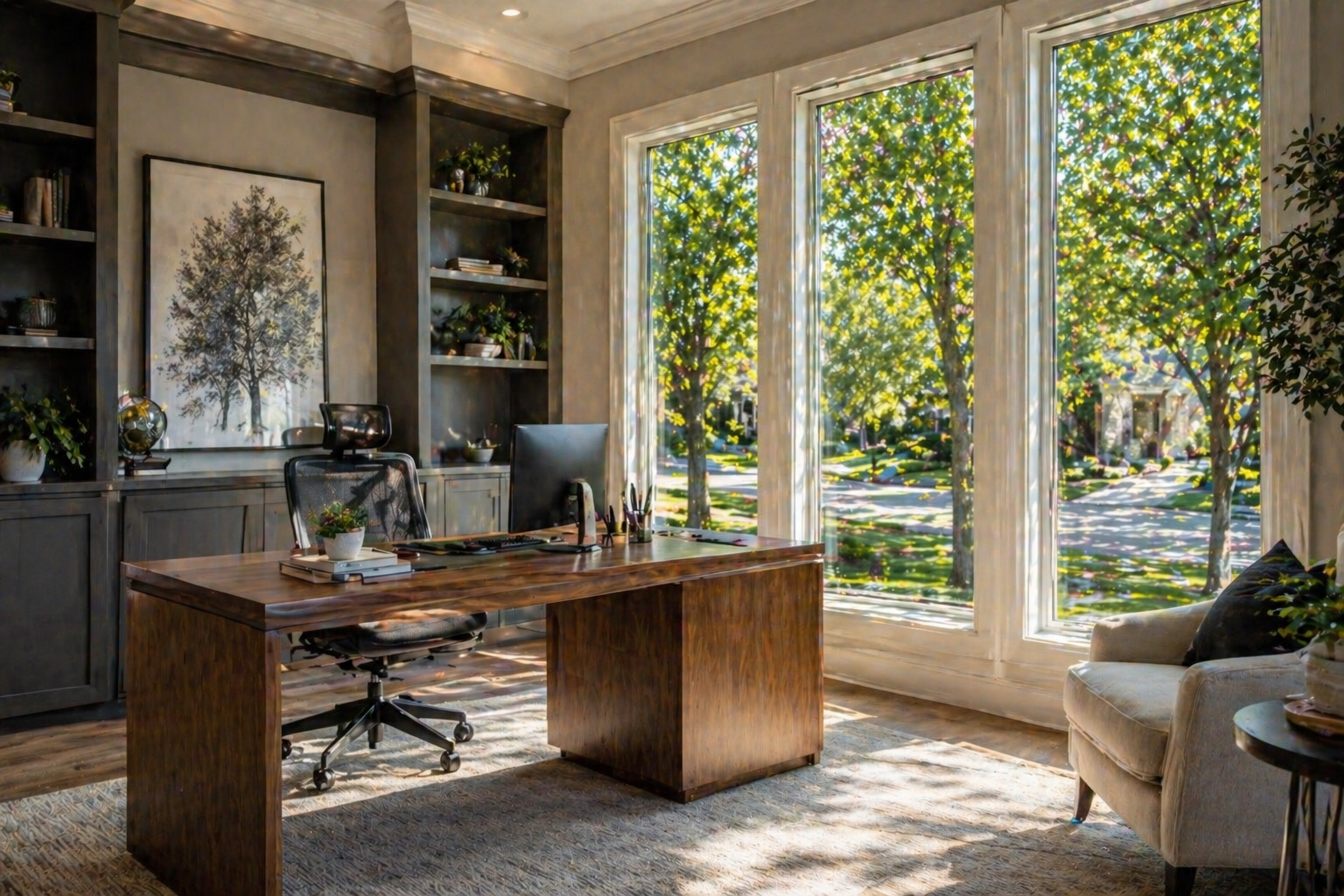
At $350K–$500K, you're getting homes with dedicated office rooms — not converted closets or shared dining tables. Real, door-closing, Zoom-call-taking, deep-work-enabling offices. Often with windows overlooking a quiet backyard or tree-lined street.
I've watched remote workers walk into their first Broken Arrow home showing and pause at the home office.
Just pause.
And you can see them doing the math in real time. Realizing what their work life could feel like with a room like this. Realizing how much of their current burnout is simply about not having physical space to work in.
That pause tells me everything.
The Rose District — Community and Connection Right in the Neighborhood
One of the biggest challenges for remote workers isn't the work.
It's the isolation.
When your commute is twelve steps from your bedroom to your office, the social infrastructure of daily life — the coworker conversations, the lunch breaks, the spontaneous interactions that fill the human need for connection — disappears.
Cities that solve this problem for remote workers win. Cities that don't lose them within two years.
Broken Arrow solves it.
The Rose District — Broken Arrow's charming historic downtown — gives remote workers exactly what they need without the chaos of urban density.
Walkable. Full of local coffee shops where you can work for a few hours and have a conversation with the person at the next table. Lined with restaurants for a real lunch break that doesn't involve your own refrigerator. Home to farmers markets, live music, community events, and the kind of regular human contact that keeps remote work from hollowing you out.
It's not just an amenity. For remote workers specifically, it's a lifeline.
The Fastest Internet and Best Infrastructure in the Metro
Let's be practical for a moment.
Remote work runs on internet. Everything else is secondary.
Broken Arrow has robust broadband infrastructure with high-speed fiber options available across the city and its neighborhoods. This is not a question mark. It's not something to research anxiously before you commit. The connectivity is there.
Coworking spaces are also available for days when you need a change of environment or a professional setting for an important call or meeting — and the proximity to Tulsa means even more coworking options are within easy reach.
The infrastructure works. That's the baseline — and Broken Arrow clears it easily.
The Lifestyle Beyond the Laptop
Here's what remote workers who make this move consistently tell me six months later.
They came for the financial reasons. They stayed because they built a life they actually like.
Broken Arrow gives remote workers:
800+ acres of parks and trails — for the between-calls walks, the morning runs, the Friday afternoon decompression that makes the week worth it.
A genuine food scene — local restaurants, growing dining options, and easy access to everything South Tulsa and Tulsa proper have to offer just 20 minutes away.
Community events year-round — the Rose District festivals, the sports leagues, the neighborhood gatherings that fill the calendar with the kind of social texture remote work often strips away.
Lake access — Tulsa's surrounding lakes are a short drive and a completely different world. For remote workers who want to close the laptop on a Friday and actually get somewhere beautiful — it's right there.
A city that's safe enough to actually enjoy — evening walks. Bike rides. Kids playing outside. The ability to be present in your neighborhood without the ambient anxiety that high-crime areas create.
The Honest Trade-Offs — Because I Always Give You Both Sides
It's car-dependent. Outside the Rose District, Broken Arrow requires a car for daily life. No meaningful public transit. For remote workers coming from walkable cities, this is the biggest lifestyle adjustment. It's manageable — but it's real.
It's not an urban core. Broken Arrow has genuine character and culture — but it's a suburb. If you need the energy, density, and scale of a major city every day, this is a different experience. For most remote workers, that's the point. But it's worth knowing.
Building your social circle takes intention. Broken Arrow has the infrastructure — the Rose District, the events, the community culture. But without an office to walk into, building friendships requires showing up deliberately. It happens. It just doesn't happen automatically.
The weather is Oklahoma weather. Dramatic storms. Hot summers. Occasional winter ice events. Tornado season is real — but the Tulsa metro, including Broken Arrow, sees far less severe activity than Oklahoma's broader reputation suggests. Most remote workers who move here adapt quickly and find the seasons more interesting than alarming.
Is Broken Arrow the Right Move for You?
Broken Arrow tends to be an ideal fit for remote workers who want:
- One of the safest living environments in the country
- A real home with a real home office at a price that finally makes sense
- Enough community and social infrastructure to avoid isolation
- A pace of life that supports deep work and genuine recovery
- Financial freedom — not just affordability
- A suburb with character, not just convenience
It may not be the right fit if you need:
- Dense urban walkability for daily errands and socializing
- The energy of a large city core every day
- Public transit
Ready to Talk About Broken Arrow?
If Broken Arrow sounds like the environment your remote work life has been missing — or if you want to compare it honestly against Tulsa proper, Bixby, or Jenks — I'd love to have that conversation.
No pitch. Just an honest discussion about what fits your work, your life, and your goals.
Because the right city doesn't just change your commute.
It changes everything.
📞 918-637-7826 📧 sabrinashaw@allwaysrealtygroup.net 🌐 sabrinashawtulsarealtor.com
Sabrina Shaw Tulsa Oklahoma Realtor | Allways Realty Group — brokered by eXp Realty
Specializing in relocation clients, luxury homes, new construction, and move-up buyers across Tulsa, Bixby, Broken Arrow, Jenks, Owasso, Sapulpa, and surrounding areas.
With over 160 homes closed and $55M+ in sales volume, Sabrina is a top 10% agent in the Tulsa MLS and a Master Certified Negotiation Expert (top 5%), known for strategic pricing, strong contract management, and a modern digital marketing approach.
Her clients become clients for life through the Allways Home Support™ program offering continued access to a moving truck, tool shed, BenefitHub savings, and a trusted network of professionals long after closing.